How to Read a Sensus Water Meter Cubic Feet
![Gas piping in New Jersey (C) Daniel Friedman]](https://inspectapedia.com/plumbing/Gas_Pipe_HaddonfieldNJ_Gill_238_DJFss.jpg) Gas Pipage Specifications
Gas Pipage Specifications
- POST a QUESTION or Annotate about LP gas pressure, propane gas pressure level, and natural gas pressure in piping, at regulators, at appliances
InspectAPedia tolerates no conflicts of involvement. We have no human relationship with advertisers, products, or services discussed at this website.
LP or Propane Gas Pressures & Natural Gas Force per unit area questions & answers:
Questions, answers, FAQs near the common operating pressures of natural gas and LP or liquid petroleum gas at the gas regulators, in edifice gas pipage and at gas appliances.
This commodity series gives the standard pressure ranges and pressure settings for LP gas, propane gas, and natural gas fuels, including pressures found in the distribution service piping, in the in-building gas piping, and at gas fired appliances such equally gas stoves, clothes dryers, furnaces, boilers, and LP gas or natural gas fired h2o heaters. Since there several ways that people express gas pressures we include more than on description of common LP gas or natural gas organization operating pressures in this commodity.
We as well provide an ARTICLE Alphabetize for this topic, or you tin can endeavor the page top or bottom SEARCH BOX as a quick way to discover information you need.
Gas Pipage Materials, Sizes, Codes, Specifications for LP or Natural Gas in Residential Systems
Question: James W. Howe on Size of Gas Piping Required
2016/09/26 James w Howe Jr said:
I was taught to Ever apply copper flex with LP gas and black pipe with NG. I'm am Non talking near force per unit area here! That stated, my supply is 2 100 lb tanks with an "automatic switch over valve". The lines from the tanks to the valve are i/eighth inch.
I need to feed a 30 inch 5 burner gas stove with a convection oven, a gas clothes dryer and a tankless 10L water heater that has a 1/2 inch gas inlet. Instead of running ane/2 inch copper flex with Ts to each appliance, do i need to increase the volume in the system to take enough gas to feed all three appliances.
If I was using NG, i'd install at least a ten human foot piece of i 1/four black pipe to build up the volume then run 1/2 inch Ts with i/2 inch pipe to the appliances. With LP I'd use 3/8 copper flex for the dryer and stove and the i/2 inch called for for the h2o heater, BUT, I need to get enough volume first so how should I proceed? All of the answers on your site deal with force per unit area and THAT is not the consequence hither!
Forgot my contact info: jwhowejr@centurylink.net
[Click to enlarge whatever image]
Answer:
Thanks for the comment and question, James, it helps us realize where we need to work on making our text more than clear or more than consummate. A competent onsite inspection by an expert ordinarily finds additional clues that would permit a more accurate, complete, and authoritative answer than we can give by email alone.
You will detect boosted depth and particular in articles at our website. See the ARTICLE INDEX link at the cease of this commodity for a library of information about LP and natural gas piping, installations, equipment, pressures, regulators, etc. That said I offer these comments.
There's quite a listing of types of piping material approved for use in gas piping systems; the distinctions I have seen are well-nigh the application - location such as above or beneath ground rather than the fuel difference between LP and NG; there have been, historically, opinions about gas pipage and corrosion differences betwixt the sources (thence the history of "dirt legs" on NG pipe systems.
 The list of gas piping materials - part of your question, depending on where the pipe is used, includes aluminum (in some locations and never beneath footing), brass (yellow - the erstwhile traditional gas pipage constitute indoors in older buildings), copper type Fifty or K rated for gas systems, atomic number 26 (black ductile iron) in a higher place footing and perchance below basis in some jurisdictions, PE and PVC for outdoor undercover use, and of course thinwall corrugated, coated flexible copper appliance connectors.
Scout out: Some jurisdictions such every bit New York City specifically prohibit use of some piping materials such as cast fe, copper, contumely, aluminum, and metallic tubing (with exceptions).
I haven't seen piping approval distinctions based on fuel but I think some opinions on that stem from differences in fuel moisture and contaminants, hence the "dirt leg" we see on older iron gas piping systems; I call back that nosotros don't see galvanized fe considering corrosives in NG supplies may cause coating loss and bottleneck; at the end of the day it's the local plumbing inspector whose word is law.
Run across NFPA #58 adopted by many jurisdictions permitting either type of steel pipage equally long equally it'southward certified to run across ASTM A53 steel pipe standards;
Hither'southward an extract example from a local urban center gas code pertaining to natural gas piping. LPG regulations will sometimes differ.
New NG gas pipage can exist of Schedule 40 steel pipe with threaded fittings, Type L rigid copper tubing with brazed fittings, Type L soft copper tubing with flared fittings, or flexible CSST (corrugated stainless steel tubing) with manufacturer provided fittings. - City of Brownton, MN 55312 www.cityofbrownton.com (outside Minneapolis/St. Paul MN).
Bottom line: to comply with piping materials choices you need to find out what local building or plumbing inspectors will have as rules vary by jurisdiction.
I agree that 1/8" diameter is not likely to provide adequate flow rates to multiple appliances nor over altitude. Typically the plumber connecting multiple appliances uses a larger line to bring gas into the building.
Also see GAS PRESSURES LP vs NATURAL GAS - the domicile page for this topic.
In that location we discuss gas pressure drib in long runs or small piping sizes. Y'all'll see that pressure and pipe size and delivery rates are connected. P1V1 = P2V2.
Even for curt piping runs there are recommended minimum pipe diameters. None of them in current standards for gas piping is 1/8".
Gas tank switchover valves for multiple LP tank installations
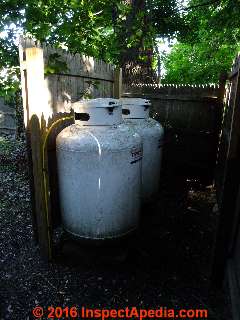
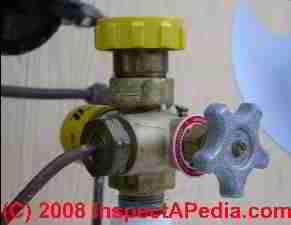
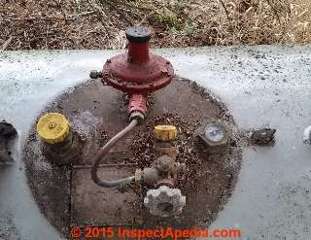
For other readers, Automatic or transmission switchover valves: I'yard indeed not sure that we're talking about the same device, nor that information technology has to practice with gas piping size and pressure level.
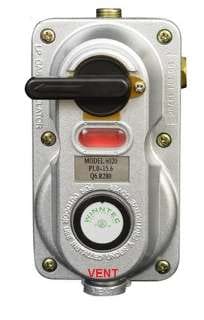
Switchover valves used, e.m. in Australia, Canada, the U.Due south., the U.Chiliad. and other countries switch between two LP tanks then that as fuel runs low in one LP tank the homeowner can switch to the full tank. Nosotros also call those likewise "changeover valves". A changeover valve is particularly useful when the empty LP tank is to be physically swapped-out for a total one.
Changeover valves are sold in both transmission and automatic forms. Some changeover valves are combined with a gas regulator equally shown in our photo above. Shown is a Winntec Model 6020 P1.0-15.6 Q6.R280 LP gaws regulator and changeover valve combined. This changeover valve is sold at plumbing and heating suppliers and at some RV suppliers such every bit campingworld.com.
Reader follow-up: you do know what NPT stands for, right?
019/09/26
James Said:
Why exercise [-es everyone I ask] seem to have to e'er go back to talk about pressure. My run is only about ten feet so pressure IS NOT an upshot! I as well have to approximate that you are completely unfamiliar with an automatic switch over valve. I realize that they are seldom used anymore, but if y'all don't take cognition of them, you should have passed the question to someone who does.
The last i knew, I live in the good 'ol USofA and in this country, we have something called the National plumbing Code. Since I am not a licensed plumber, i do not have a copy then asked a question of a website that I idea could give me a reasonable respond.
To my dismay that is Not the case. Thanks, but no thanks, i'll seek my answers elsewhere! Past the mode, the outlet on the automatic switch over valve is ane/ii inch NPT…you practice know what NPT stands for, right? jwh,jr
Moderator answer: delight be conscientious almost quick, shallow "answers" to questions involving life-safety
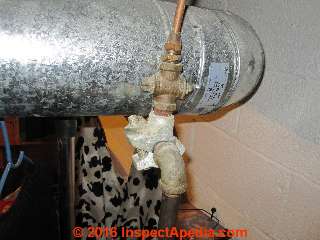 Of course pressure volition exist uniform throughout a system until appliances are using fuel. And so the pressure driblet will depend on the length and size of pipage. And use of a switchover or equally nosotros prefer changeover valve on LP tanks does not meliorate the requirements for gas pipe sizing based on the catamenia requirements.
Sorry that our initial reply was disruptive for you. We have readers in over 50 countries and so we don't assume that we know where they live. "National Plumbing Code" itself is a standard that varies by land.
Merely in the U.Southward., the National Plumbing Code is not the best resource for answering your question. Instead you lot'll want to see NFPA 54 that you can access for free, online. We include the necessary information to practise so at the end of this article.
Sorry also to see y'all and so aggravated that your email digresses to insults. We endeavor our best to serve millions of readers a month, finding information if we don't already have it, researching for authoritative, unbiased sources and eschewing arm-waving opinion.
Sometimes, depending on how your question has been worded, its length and content, we may not correctly understand the central question.
We too understand the natural wish of a reader who says "never mind all that malarkey, just TELL ME THE ANSWER". Simply sometimes the questioner appears to united states to be facing life safety hazards too as building code and standard, permits, or licensing bug that nosotros recall requires a bit more information to come upward with a reasonable and safe solution to a problem.
InspectAPedia is an contained publisher of building, environmental, and forensic inspection, diagnosis, and repair information provided complimentary to the public - we have no business concern nor fiscal connexion with whatsoever manufacturer or service provider discussed at our website.
We are defended to making our information every bit accurate, complete, useful, and unbiased as possible: we very much welcome critique, questions, or content suggestions for our spider web articles. Working together and exchanging data makes u.s.a. ameliorate informed than whatsoever individual can exist working alone.
Watch out: It's more than important to understand that likewise high or too low gas pressures are unsafe, risking not just appliance malfunction but fire or explosion or fatal carbon monoxide poisoning.
For this reason, nobody, even the most generous plumber, if she or he has an ounce of sense, is going pretend that she can tell someone exactly what kind and size of gas piping is required for an installation well-nigh which she knows next to nothing.
The danger of giving a person of unknown grooming and skill "how to" communication is that at that place is almost always ane or more important considerations that an on-site expert would notice but that are not offered by the person request the question. When discussing fuel gas piping in that location's the ever nowadays gamble that the reader later blow himself up or catches his building afire. That caveat made nosotros continue to effort to assist you out:
Reader follow-up: and so answer my question: how large should my gas pipes be? Do I need a manifold with multiple outlets?
016/09/27 James West. Howe Jr. said
Insults? I echo my question: since there is only a one-half inch outlet on the switchover valve, should I employ black piping with LP to increase the book since even with the new products on the market for LP, I haven't seen any that accept a bore larger than iii quarters of an inch OR should I simply put a short manifold on the valve outlet with three half inch outlets on information technology and run 3 one-half inch lines, one to each apparatus? jwh,jr
Moderator answer: excerpts on gas pipe diameter & length & BTUH or Cubic Feet per Hr Gas Supply for NG or LPG from model gas codes & resources
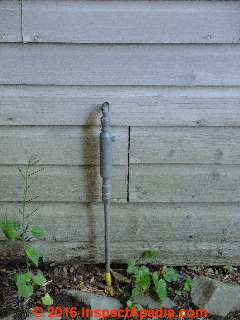 James:
Cheers for clarifying your question to focus on LP gas pipe size or diameter for a 10-pes length for an un-specified number of appliances or gas-fueled equipment.
Your original question mixed pipe blazon, pipe bore, manifolds, fuels, tank changeover valves, and appliances of unknown input or BTUH requirements and then we were not sure what answer would be most helpful.
You asserted that you're asking just almost pipe diameter and yous don't intendance about force per unit area, but information technology'due south important to understand that it'south inadequate piping size (or improper regulators or regulator settings) that would deliver inadequate gas pressure level (or catamenia charge per unit in CFM per infinitesimal) at one or more appliances.
Typically the plumber measures gas piping pressure commencement with all appliances off, then with them on. If the pressure with all appliances using fuel falls below the required input pressure at the apparatus regulators the plumber knows to choose amid
increase pipage diameter size or to go to a two stage regulator system. A two stage regulator organisation is non unremarkably required in a typical dwelling gas piping installation.
You referred past email to lacking a copy of a model plumbing code such equally the U.South. National Plumbing Lawmaking
As you'll read Affiliate four, Gas Piping Installations, Section FGC 401, in the New York Urban center Gas Code, institute at https://InspectAPedia.com/plumbing/NYC_Gas_Code_CH_4_Gas_Piping_Installations_2014.pdf - provided free at InspectApedia.com equally well as by New York City, or as you can read in what's the best resource about gas piping installation, the National Fuel Gas Lawmaking NFPA 54, proper sizing of gas pipage cannot be decided by arm-waving, shouting, nor insult.
Rather one needs to do some simple arithmetic, looking at piping lengths, diameters, fuel blazon, AND the input BTUH (or cubic feet of gas per hour) required the appliances on the gas pipe arrangement.
Lookout out: beware of a simple "just give me the answer" demand for questions that are incomplete, for which a safe proper respond requires more than information, and for which a hasty one-size-fits'all answer could kill you or others.
I can't answer your gas manifold question as that'southward a local plumbing determination based on infinite, convenience, and other factors suggested here.
LP Gas Pipe Sizing Codes, Tables & Examples
- 3/eight" OD Copper tubing ten anxiety long tin support 49 KBTUH (Thousand BTUs/Hour) of gas flow or supply at xi inches W.C. with a 0.5" W.C. force per unit area drib.
We're using this force per unit area range equally information technology's well-nigh common for household appliances but you will need to check the specifications for your own appliances.
- 1/2" OD Copper tubing 10 ft. long can support 110 KBTUH as to a higher place
- 3/four" OD Copper tubing 10 ft. long can support 348 KBTUH as above
- 1/2" fe piping (of an approved blazon) x ft. of length tin deliver 291 KBTUH as above
- 3/4" fe piping 10 ft. of length can deliver 608 KBTUH as in a higher place
- Meet additional gas piping sizing tables and guidelines in the Codes and IO Manuals cited and provided beneath.
Note that these information points are for xi" W.C. gas line sizing & copper.
Different data than that given in the gas pipe sizing just above will be obtained if you are designing a two psig gas line.
What'southward the Deviation between an 11" wc gas pipage system and a 2 psig gas pipage organisation?
11" wc is the nearly-mutual residential gas piping organisation but some new installations are beingness installed using a 2psig gas pipage organisation. ("psig" refers to psi read on a pressure judge or "gauge pressure".
xi" W.C. (H2o Column) = 0.397 psig.
Formula to convert force per unit area P to psi: psi = P / 27.679904842545
Or for convenience ane psi = 27.seven in W.C.
What's the difference between PSI, PSIA, and PSIG?
PSI = pounds per square inch
PSIA = atmospheric pressure or pressure if measured compared to a pure vacuum. At sea level atmospheric pressure is fourteen.seven PSIA
PSIG = guess pressure expressed in psi. Gauge force per unit area will show 0 at sea level. Since most building gas pressures are read using a pressure guess information technology is proper to refer to psig or gauge pressure level.
An case for 2psi piping systems is given below.
Maxitrol 325-series 2 psig Gas Pressure level RegulatorGAS Menses RATE from Open up PIPE | ||||||
Flow of Natural GasLess Escape Book 3 | Length of Service Piping | |||||
| 25 ft | fifty ft | 100 ft | ||||
| BTUs | CFH | BTUs | CFH | BTUs | CFH | |
| 3/4" Iron Pipe @ 6" w.c. | 600K | 600 | 440K | 440 | 315K | 315 |
| three/8" OD Tubing @ 2 psi | 210K | 210 | 148 | 148 | 105K | 105 |
Notes to the tabular array higher up:
- For Natural Gas Maxitrol assumes 1000 btus / cubic human foot of gas - this allows translation of cu.ft. into BTUs
- CFH = Cubic Feet per Hour
- Less Escapement Volume: Gas at half dozen" westward.c. escapes from a three/4" pipe at about three times the rate of gas from a three/ viii" OD tube at ii-psi. The nautical chart below shows flow comparisons at the discharge end. From the standpoint of uncontrolled escape of gas within a building, the 2-psi organization has less menstruation than the 6" w.c. system.
- ANSI Z21.80 is the ANSI standard for line pressure level regulators, intended for application in natural gas piping systems and LP (propane). Maxitrol's 325 Serial L-models are CSA certified (Z21.80) for two-psi inlet force per unit area, with the 7 to 11 (inches w.c. outlet) bound.
- Source: MAXITROL 2-psi GAS Pipage SYSTEMS 325 Serial GAS REGULATORS for DOMESTIC GAS Pipe [PDF] (2005) Maxitrol Visitor 23555 Telegraph Rd., P.O. Box 2230 Southfield, MI 48037-2230 U.S.A. www.maxitrol.com
- Meet too GAS BTUH, CUBIC Anxiety & Free energy
- Encounter likewise GAS PRESSURES LP vs NATURAL GAS
Gas Piping Sizing Codes, Specifications, Resources
- NFPA 54, ANSI Z223.1, (2015) The gas piping tables in NFPA 54 include a reminder of allowances needed to account for bends, fittings, valves - effectively those increase the effective "length" of the pipage when figuring lengths and pipe size requirements. Similar gas pipage size charts are given past LP gas suppliers. This standard provides minimum condom requirements for the design and installation of fuel gas piping systems in homes and other buildings.
As NFPA Explains NFPA 54 addresses the following:
Requirements cover the installation and operation of fuel gas piping systems, appliances, equipment, and related accessories, with rules for piping systems materials and components, piping arrangement testing and purging, combustion and ventilation air supply, and venting of gas-fired appliances and equipment.You tin purchase a copy of the National Fuel Gas Lawmaking from NFPA at http://www.nfpa.org/codes-and-standards/all-codes-and-standards/list-of-codes-and-standards?manner=code&code=54
NFPA likewise permits viewing of NFPA 54 online, free if will take the time and trouble to register with the clan. NFPA = the National Fire Protection Association, whom you can contact at
NFPA
1 Batterymarch Park
Quincy, Massachusetts The states 02169-7471
Phone +one 800 344-3555 (U.S. & Canada) +1 617 770-3000 (International) - APPENDIX A: SIZING & CAPACITIES of GAS PIPING [PDF] as adopted in the U.Due south. by Virginia'southward adoption of the the IFGS and the National Fuel Gas Code will provide details of the information yous need for an actual, safe respond to your gas piping questions.
- RESIDENTIAL PROPANE INSTALLATION GUIDE - GAS PIPING MATERIALS [PDF] Minnesota Propane Gas Clan, PO Box 220, Princeton MN 55371, Tel: 763-633-4271, Website: www.mnpropane.org retrived 2020/05/08, original source: www.lakesgas.com/images/2019/Residential-Propane-Guide.pdf is another example that lists allowable gas pipe materials
- "LP GAS LINE SIZING CHARTS", [PDF] LP-Gas Equipment Inc. 881 Hersey St. St. Paul, Minnesota 55114 USA, Telephone (651) 646-1177 Minnesota: 800-652-9072 Out-of-State: 800-328-9222 E-postal service: info[at]lp-gasequipment.com, retrieved 2016/09/27 original source: http://www.lp-gasequipment.com/products/pdf/LPGas_Cat2010_p157-175.pdf There you'll notice the following tables:
- Gas pipage or tubing length vs. pipe size for 11" W.C. - gas line sizing chart for copper tubing & pipe
- Gas pipe or tubing length vs. pipe size for two PSIG - gas line sizing nautical chart for copper tubing & pipe
- Gas pipage or tubing length vs. pipe size for 10 PSIG - gas line sizing chart for copper tubing & pipe
- Gas pipe or tubing length vs. pipe size for 10 PSIG - gas line sizing nautical chart for polyethylene tubing
- Gas pipe or tubing length vs. pipe size for ten PSIG - gas line sizing chart for CSST corrugated stainless steel tubing (Also encounter GAS Pipe, FLEXIBLE CSST)
- Liquid flow gas supply sizing charts rated in gallons per hour vs length of pipe and pipe diameter
- Gas equipment orifice size (and drill size) vs. BTUH chapters at diverse pressures
- Other tables, charts, calculations useful to gas piping installers and technicians
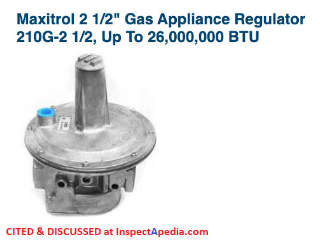
- MAXITROL 2 1/two" GAS APPLIANCE REGULATOR 210G-ii ane/two & 220 Series INSTALLATION INSTRUCTIONS [PDF] upwards to 26,000,000 BTU - (shown above) as offered past globalindustrial.com, retrieved 2021/02/09, original source: https://www.globalindustrial.com/
Website Excerpt:
The 210 Series Is A Lock-Upwards Type Regulator And Compiles With Codes Using This Specification. The 210 Series Has Been Designed For Maximum Control Role In An Easy To Utilize Packet. The Series Is Intended For Use With Gas-Fired Boilers, Steam Generators, Industrial Furnaces, Ovens And Similar High Demand Equipment. The Balanced Valve Design Eliminates The Inlet Pressure level Effect Acting On The Valve. Regulating Stability Is Improved And Hunting Tendencies Reduced By The Use Of Dampening Mechanisms In Both The Sabbatical Outlet And Sensing Tube. You lot Go Precise Regulation Over A Broad Range Of Pressures And Period Rates With The 210 Serial, Including A "Nix Governor" Application. Made in the USA. - MAXITROL GAS REGULATORS CAPACITY CHARTS 210-series [PDF] (2006) Maxitrol Company 23555 Telegraph Rd., P.O. Box 2230 Southfield, MI 48037-2230 U.S.A. www.maxitrol.com and in Europe: Maxitrol Company 23555 Telegraph Rd., P.O. Box 2230 Southfield, MI 48037-2230 U.Due south.A. www.maxitrol.com - retrieved 2021/02/09, original source: industrialcontrolsonline.com
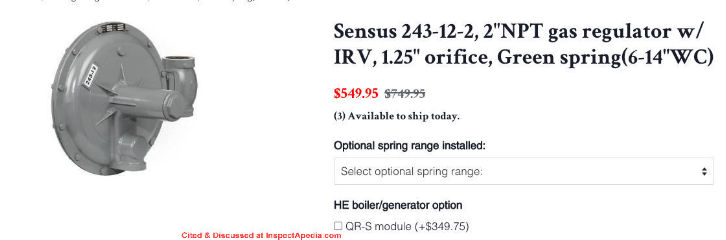
- SENSUS 243 GAS REGULATOR SPECIFICATIONS [PDF] (2013) Sensus Corp., 805 Liberty Boulevard, DuBois, PA 15801 United states Website: sensus.com/gas Tel: 1-800-375-8875
- SENSUS 243 GAS REGULATOR IO Manual [PDF] Op. Cit. - Includes Capacity Tables for natural gas for this regulator model.
In that reference you will meet that for longer gas pipe runs, in backlog of 100 feet, copper tubing in whatever size, 3/eight" to 7/8" O.D. is not permitted and won't work.
Instance Natural Gas Pipage Code Excerpts
Here are a few explanatory excerpts from New York City's natural gas pipage code; nosotros provided some LP gas piping length examples in an earlier answer. :
401.iii [Natural Gas Piping ] Modifications to existing systems.
In modifying or adding to existing piping systems, sizes shall be maintained in accordance with this affiliate.
401.4 [Natural Gas Piping ] Boosted appliances.
Where an additional appliance is to exist served, the existing pipage shall be checked to determine if information technology has acceptable capacity for all appliances served. If inadequate, the existing organisation shall be enlarged equally required or dissever pipe of adequate capacity shall exist provided.
401.iii Modifications to existing [Natural Gas Piping ] systems.
In modifying or adding to existing piping systems, sizes shall be maintained in accord with this chapter.
401.4 Additional [Natural Gas Pipage ] appliances.
Where an boosted appliance is to exist served, the existing piping shall exist checked to determine if it as adequate capacity for all appliances served.
If inadequate, the existing system shall exist enlarged as required or dissever piping of acceptable chapters shall exist provided.
402.three [Natural Gas Piping ] Sizing.
Gas pipage shall be sized in accordance with one of the post-obit:
1.Pipe sizing tables or sizing equations in accordance with Department 402.4.
two.The sizing tables included in a listed piping organization's manufacturer's installation instructions.
3.Other approved engineering methods.
4.Individual outlets to gas ranges shall not exist less than ¾ inches (nineteen mm) NPS .
402.iv [Natural Gas Piping ] Sizing tables and equations.
Where Tables 402.4(1) through 402.four(5) are used to size piping or tubing,
the pipe length shall exist determined in accord with Section 402.4.1, 402.4.2 or 402.4.3.
402.4.1 Longest [Natural Gas Piping ] length method.
The pipe size of each section of gas piping shall exist determined using the longest length of pipe from the betoken of
delivery to the virtually remote outlet and the load of the section
402.iv.two [Natural Gas Piping ] Branch length method.
Pipe shall be sized every bit follows:
1.Piping size of each department of the longest pipage run from the indicate of commitment to the nearly remote outlet shall exist determined using the longest run of pipe and the load of the section.
2.The piping size of each department of branch piping non previously sized shall be determined using the length of pipage from the point of delivery to the most remote outlet in each branch and the load of the section.
402.4.three [Natural Gas Piping ] Hybrid pressure level.
The pipe size for each section of higher force per unit area gas pipe shall exist adamant using the longest length of piping from the bespeak of delivery to the most remote line force per unit area regulator. The pipe size from the line pressure regulator to each outlet shall exist determined using the length of piping from the regulator to the about remote outlet served by the regulator.
Examples:
Using Schedule 40 Metallic Pipe and Natural Gas, where inlet pressure [at the appliance] must be less than 2 psi, the pressure level driblet in the system must be no less than 0.iii" w.c. [Later tables in this reference permit grater pressure drop and and so will support higher CFM of gas per hr for the same bore and lengths of pipe].
- 10 feet of one/2" pipe (actual ID 0.622) can provide 131 cubic feet of gas per 60 minutes
- 10 anxiety of 3/4" pipe tin can provide 273 cubic feet of gas per hour
- 20 feet of one/two" pipe can provide 90 cubic feet of gas per 60 minutes
- 20 anxiety of 3/4" pipage can provide 188 cubic feet of gas per hour
The codes I cite requite detailed tables of pipe types, diameters, lengths, and the pipe's capacity to deliver some number of cubic feet of gas per hour. Take a wait at your own appliances to see their requirements. Or you can await up typical appliance BTUH requirements in the documents we've cited.
402.v Allowable [Natural Gas Pipe ] pressure level driblet.
The design pressure loss in any pipage system nether maximum likely menstruum conditions, from the betoken of delivery to the inlet connection of the apparatus, shall be such that the supply pressure level at the appliance is greater than or equal to the minimum force per unit area required by appliance.
403.1 [Natural Gas Piping ] General.
Materials used for piping systems
shall be new and comply with the requirements of this chapter or shall be canonical.
403.1.1 [Natural Gas Pipe ] Pipe size and pressure limitations.
1. All requirements for installation of gas distribution pipage with operating pressures at ½ psig (3.5 kPa gauge) or less and above ½psig (iii.5 kPa gauge) shall be in accordance with Affiliate 4 of this lawmaking.
2. Gas distribution piping operating at a pressure level of over ½psig (three.5 kPa estimate) to 5 psig (34.5 kPa guess) and size 4 inches (102 mm) or larger shall be welded.Exception:Manufactured and listed gas trains provided with the appliance may be threaded
three. All gas distribution piping operating at a pressure in a higher place five psig (34.5 kPa gauge) shall be welded.
4. All welding of gas distribution pipe shall be subject to special inspection as set forth in Section 406.
5. All piping 4 inches (102 mm) and greater operating at pressure exceeding 5 psig (34.5 kPa gauge) must be butt welded, discipline to special inspection and radiographed.
6.Threaded piping may exist used up to 4 inches (102 mm) at pressure no greater than ½psig (iii.5 kPa gauge).
403.ii Used [Natural Gas Piping ] materials.
Used pipe, fittings, valves and othermaterials shall not be reused.
403.3 Other [Natural Gas Piping ] materials.
Material not covered past the standards specifications listed herein shall be investigated and tested to make up one's mind that it is rubber and suitable for the proposed service, and, in addition, shall be recommended for that service by the manufacturer bailiwick to approval past the commissioner.
403.4 [Natural Gas Piping ] Metallic pipe.
Metallic pipe shall comply with Sections403.4.1 through 403.4.four.
403.iv.1 [Natural Gas Piping ] Cast iron.
Bandage-iron pipe shall non be used.
403.four.2 [Natural Gas Pipage ] Steel.
Carbon steel and wrought-fe piping shall be at to the lowest degree of standard weight and shall comply with one of the following standards:one.ASME B36.x, 10M2.ASTM A 53/A53M; or3.ASTM A 106.403.4.3 Copper and brass.
Copper and brass pipe shall no tbe used.
403.four.4 [Natural Gas Piping ] Aluminum.
Aluminum-alloy pipe shall not be used.
403.v [Natural Gas Pipage ] Metallic tubing.
Metallic tubing shall not be usedexcept as provided in Section 405.5
Watch out: There are life safety hazards involved when fooling with gas piping and appliances. Cheque with your local plumbing officials about what type of gas piping are permitted where you live, and while you lot're at it, enquire what gas piping or plumbing permits and safety and code compliance inspections are required where you live.
Natural Gas Appliance Operating Pressures in WC, millibars, Pascals, PSI or ounces of pressure
A common operating pressure level for natural gas appliances is around vii inches of water column (WC) or re-stating this in equivalent measure, that's 14.9 millibars or 1743 Pascals or Pa, or about 0.25 psi (pounds per foursquare inch) or about four ounces of pressure per square inch.
Run across NATURAL GAS Apparatus PRESSURES for details.
LP or Propane Gas Apparatus Operating Pressures in WC, millibars, Pascals, PSI or ounces of pressure
A common operating pressure for liquid petroleum or LP gas appliance is 10" - 11" of water column (WC) or re-stating this in equivalent measures, that'due south 27.four millibars or 2491 - 2739 Pascals or Pa, or about 0.36 - 0.xl psi or nigh 5.78 to 6.36 ounces of force per unit area per square inch.
See LPG & PROPANE Appliance PRESSURES for details.
Reader Q&A on gas piping
@Joe,
Here is a propane-to-natural-gas connector kit - this example is the Permasteel Natural Gas Conversion Kit for Kenmore Grills vi-Burner + Side Burner.
As you can see, those are different materials.
Watch out: Some gas connector lines, but not all of them, are rated for both LPG and natural gas fuels.
I would not utilize propane gas connectors nor other parts on a natural gas barbecue Before reading the specifications for your specific product.
Below is a connector hose described equally rated for propane gas.
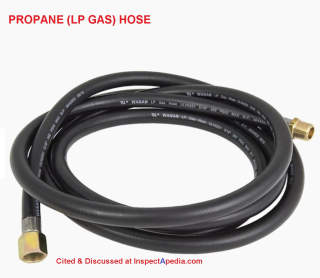
Accept a look at the materials and besides take a look at the requirements to convert a gas grille from Propane to Natural Gas - my second illustration I'll postal service in a minute.
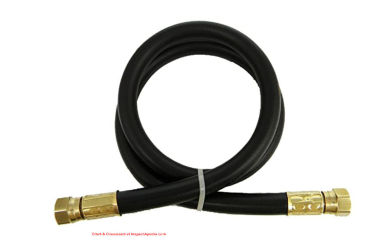
Bottom line:
You MIGHT be able to utilise the same hose for connecting to EITHER Propane or Natural Gas **if** the hose is specifically rated for both fuels.
An example is shown beneath, from Grand.B. Sturgis Co., a hose that is specifically rated as OK for either fuel (shown as sold at Amazon) described as
3/8" ID Thermo Condom High Pressure Propane/Natural Gas Hose with 3/8" 45 Degree Female Flare Swivels on each stop.
Versatile hose can be used for any Propane or Natural Gas Appliance connection. The Female Flare Swivels make connecting to the supply or appliance easy.
Thermo Rubber Hose stays very flexible in cold weather.
350 PSI Max Pressure Rating
Certified to UL21, UL569, CAN 8.3
shown higher up
Can I use a 3/8 propane hose to run a natural gas barbecue
@STEVEN ALTMAN,
Thanks, that'due south an interesting question; for which I cannot requite an administrative answer, as might a suitable civil or plumbing engineer.
I suspect that the distances are so short that what you lot propose is fine, but technically it's a menses question that could apply engineering calulations.
Or you'll endeavor the one" and monitor the event; for brusque distances similar that re-plumbing sounds minor.
my customer is adding an additional ng hot waster pressure washer to his facility. presently, he has two units rated at 415,000 btu's. The boosted unit volition exist the same. The 2 units are individually continued to a ii" main with shut offs and regulators. The new unit of measurement will be located adjacent to a existing unit supplied from a one" blackness pipe approximately 10" from the 2" supply line.
if possible, we would like to plumb into the existing 1" line for the additional unit of measurement which volition be located about 10' away. Exercise y'all encounter this as a problem? What size black pipe line would exist required for each individually for this 415,000 btu requirement ? From the to a higher place data, it seems that a 3/4" line at 25' is rated at 600,000 btu's so a i" would seem to be adequate..exercise you agree ? cheers.
Travis:
Take a expect at the input pressure that is specified on the LPG regulator that is provided with the powder-coat oven you are installing. If your supply pressure is greater than that y'all'll want a step-down regulator just alee of the oven.
That's a mutual approach when having to evangelize high gas supply rates over longer pipe runs: distribute at higher pressure level and drop downwards at the appliance;
Give thanks you for your tongue-in-cheek comment also.
80 ft is pretty long; if you don't run the larger line to closer to your burners you may find inadequate gas flow.
Thank you lot for the quick response..I have a couple of other questions. I'1000 planning on running 1 1/two" iron from a regulator like the examples to within a foot or two of furnace.. Adapting down to a ane one/four flex line for concluding connection. Practice I need another regulator of some sort at the end of the i i/2 iron pipe. 2nd question is regarding the connection of tanks to first regulator. Should I use both tanks simultaneously to feed supply line and if so would I simply use the appropriate size pipe from each tank into a tee and then into regulator..
Last merely not least a hats off and big thanks to all who are involved in running this website...and I'm impressed with modernistic's ability to go on pen in cheek when dealing with jackasses like James from above...THANK YOU!!
Apologize if this a indistinguishable comment I don't know if my first 1 got sent or I somehow just managed to erase it...
Continuing:
More examples of high BTUh gas regulators include this Sensus 243-12 model.
Likewise come across these examples of gas regulator specs and IO manuals that include helpul sizing tables; more than sizing tables are in the article to a higher place.
https://inspectapedia.com/plumbing/Sensus-243-Gas-Regulator-IO-Manual.pdf SENSUS 243 GAS REGULATOR IO MANUAL
https://inspectapedia.com/plumbing/Sensus-243-Gas-Regulator-Specifications.pdf SENSUS 243 GAS REGULATOR SPECIFICATIONS
Travis:
In the article above yous'll find the basic gas piping diameter and length limits at
"LP Gas Pipe Sizing Codes, Tables & Examples"
and just below that links to PDF files giving detailed gas pipage sizing tables that relate BTUs and pipe lengths that will work.
I suspect you will need AT LEAST one 1/iv" pipe over that lxxx ft. run.
And even though that 1/4" ID line between LP tank and regulator is quite short, your BTUh consumption ane.2 million is so swell that well-nigh-likely the whole regulator and pipe diameter need to exist increased. Have a look at the regulator make and model, then give its manufacturer a phone call.
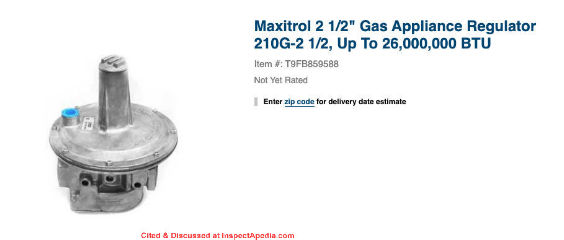
Information technology'south likely that y'all volition demand a larger capacity primary regulator at the LP tank; an example is shown beneath; ofttimes we see that for a high BTUh awarding similar yours the gas is run from tank to appliance at college pressure so is stepped downwardly by a secondary regulator merely ahead of the appliance.
The regulator I bear witness below, the Maxitrol 2 one/2" Gas Apparatus Regulator 210G-2 1/ii, tin can deliver up to 26,000,000 BTU and is probably a college capacity than you lot need, simply other models (at lower cost) are of course bachelor.
I'm installing a large powder glaze oven in my shop. xx'x10'x10" it is a propane heated unit...The unit has a max. burn rate of 1.2mil BTU and i ane/iv inlet for propane.. The tanks used for propane supply are two #420 tanks located approximately 80ft away and 12ft below the burner. Do I need to run 1 ane/4 pipage all the way dorsum to the propane tanks and will the i/4" copper line off tank to regulator allow enough fuel to run heater...Thank you
 Linda
Linda
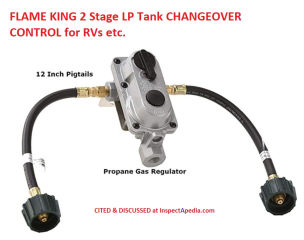
That regulator you lot show is intended for use on an RV or camper and is non intended to serve a building with longer gas line runs; I suspect that it is very under-sized and may not exist approved for the utilise you have made of it.
[Re-posted with analogy replacing link - mod]
Ok, I installed 50ft of 3/4" blackness pipage when I remodeled this barn. My programme, to use LP for furnace, dryer, range that was 5 years ago. Plans inverse. The lines were tested and tight at that time. All capped. I decided to install a gas range so I pressure tested the lines, fabricated corrections to couplings that were soap tested and showed leaks.
Retested. Everything is skilful. The line is articulate. Bought a new dual stage regulator and two tanks. [from Amazon -shown below] Installed a iii/8" blackness hose to ;my blackness pipe.
This regulator indicates that the tank is empty but I'm wondering if my black pipe line is too long and the force per unit area is the line is too low to become the gas to my range which would cause the valve in the regulator or the valve in the tank to close.
You need to be a petty more articulate on exactly where you lot are detecting no fuel.
I'm non aware of any gas regulators at appliances that tell us anything most the quantity of fuel available in the lp tank.
Fifty-fifty if your pipe is under sized for the length you would still see some gas flow, it would just be at besides low a rate or pressure.
And so permit'south commencement by being certain that there's no valve closed somewhere in the organisation.
Lookout out, if you're not familiar with proper and rubber gas pipe this is not work yous should attempt yourself as a mistake could blow the place upwards.
I am installing two twoscore# lp tanks to supply my range in my home. I have a long run (50ft) of iii/iv" black pipe to my kitchen. When I finished installing the tanks, regulator, and connections the regulator shows my tanks are empty (only filled) and no gas is getting to my range. Everything has been pressurized and soap tested and then in that location'south no leaks. I'm wondering if I demand a college force per unit area regulator, bigger tanks, or a shorter run. Any ideas?
Forrest
Thank yous very much for your generous comments. I've worked hard on this material for a long time so I'm particularly grateful when readers detect it useful.
Your questions, comments, criticism, or content suggestions are as well always welcome and helpful.
thanks so much for your very detailed article. Some people have to be jerks even when they are getting gratuitous help . I learned a lot! Thanks once more
Forrest
we are going to run a line for propane gas most threescore-65 ft, to the house. we have a 250 gal. tank. are all the dissimilar materials (coated flexible copper, alum, stainless steel) equal as far as rubber and durability?
TF
Delight detect your question and my detailed reply at present virtually the top of the article above on this page. You may need to clear or refresh your browser cache to encounter the updated page. We welcome your farther photos, comments, questions.
TF
Indeed there are plastic-coated LP gas pipe materials that are rated for outdoor and for either above-ground or for buried (underground) utilise. Those are described on the folio above and at
GAS PIPING, FLEXIBLE CSST
For long gas runs you often demand to add together a regulator.
I have a 250 gallon propane tank and have 22kw generator hooked upwardly to it. I am in the process of having a concrete deck poured and was wondering if I should go cloak-and-dagger with the propane pipage to the house fireplace(vented logs) which has never been hooked up, I would like to accept an outlet on deck for a propane BBQ pit.
The tank is nigh 110' away from the fireplace connection and the location where I want to add for the bbq is about 50 ft. Wondering what is all-time cloth to run and do I utilise tee or header underground/to a higher place before information technology goes into decking. As well as do I need boosted regulator?
Garnett In the article to a higher place y'all'll see some propane piping size guidelines and examples.
3/viii" OD Copper tubing x feet long tin can support 49 KBTUH (One thousand BTUs/Hour) of gas flow or supply at xi inches Due west.C. with a 0.5" West.C. pressure drop. Nosotros're using this pressure range equally it's nearly mutual for household appliances simply you will need to check the specifications for your ain appliances.
Then yous can see that to go 25 ft you need a larger size.
I am hooking upwardly a thirty,000 btu propane gas free standing stove heater and need to run copper pipage for aboutn25 feet simply wanting to know if I should run iii/8 pipe or 1/2 pipage
I purchased a small sixty gal auxiliary lp tank in example emergency and h2o heater during summer.i have some questions about hooking information technology up.
This was used on an rv that ran on LP. Therefore, I had to purchase a vapor valve since rv used liquid LP. Doesn't have a regulator.
ane--does the brass plumbing fixtures that attaches to the tank for vapor need to have pipe dope/tape?
two--can lp from this tank be ran into the existing regulator? Small tank will but be used in the situations above. The output will become into the larger tank.
3--can CSST be used to hook both tanks together with or w/o protection from weather? Thanks for any answers or comments.
Mike
I'm certainly not absolutely certain but your best take chances for success is to apply a large diameter gas line five/eight in for example.
The number one complaint I hear from people trying to run a generator is inadequate flow - is usuly because of using too small a diameter piping on a long run. Keep me posted.
Trying to decide if I tin can run an emergency portable generator off the house LP supply line (with bulk tank) and not impact the furnace.
I am doing this for a friend who has a medically dependent (on electricity) child. The supply line from the majority tank to the house is three/8" OD copper after the regulator.
At the business firm is a 2nd regulator with a 5/8" OD copper line on the output that so runs directly to the furnace - probably iv' of 5/8" OD piping. No other LP appliances/uses. I am hoping to tap a line off the baste leg of the furnace piping and run over to the generator using soft copper tubing.
The furnace baste leg is one/2" B.I. NPT piping. The generator is a 12,000 watt (peak), driven by a eighteen HP engine.
The generator location requires an approximately twoscore' supply line (from furnace to generator).
The generator comes with a chief regulator (intended for connecting to a 20# or 40# cylinder) and a secondary regulator mounted on the generator.
I do not currently know the furnace BTU merely the firm is an older 2 story farm house. Also, I live in Iowa where winters can be quite cold at times. My concerns? I desire to ensure I have the proper line size feeding the generator AND I do not want to "starve" the furnace when the generator is running. Any help would be profoundly appreciated. Thank you.
Nope, Terry, In my view as long as the iii/iv" NG regulator has the same pressure and flow ratings, the just difference is the pipage fitting size - that ought non hurt a thing every bit you lot'll simply have to employ the proper pipe fittings to pace down from 3/4" to i/2".
I purchased a 3/iv" NG regulator by accident to replace 1/2" regulator for NG Grill. Both have same output (seven inch WC). Should I expect failure here?
Not necessarily, Edward; the pressure and diameter alone won't tell the story; the pipage length and other restrictions may likewise mean you need a larger diameter. Yous'll come across details in the article on this page.
trying to connect 7500 duel fuel generator with 7,500 running wattage to home propane line will 1/2" sch. twoscore black pipe exist sufficient the generator people say requires one.2 cfm at seven-11 inches of water?
@Barbara C.,
Thanks for your response, Dan. I will bank check with the propane supplier too. This site is a great source and I capeesh the piece of work involved to maintain it.
Best,
Barbara
Barbara
A google Scholar search for "rodent damage gas pipe" and similar phrases turned upward manufactures on rodent-proof construction but no specific commodity (at least not in the first few pages I scanned) reporting an incident of rodents chewing through metallic gas pipage.
I'm waaay too scared to bet your life on arm-waving but I doubtable that when squirrels or other rodents chew through gas lines it's plastic or PVC piping that they attack, not copper or iron piping.
If y'all actually run across seize with teeth marks or scratches on any of the piping that'd up the business and I hope that in addition to calling your plumber you'll mail a photo of that piping hither.
Propane tanks that supply the heating banality in my habitation have slim metal pipes traveling from the tank, across the back of my house and into a larger pipe that enters the boiler room. I have found chewed nuts in the area at the top of each tank that shelters the gauges that bespeak the number of gallons in the tanks.
I am concerned every bit to whether the chipmunks could swallow through the gas lines. At that place's a large population of chipmunks and squirrels about my home due to a grove of adjacent nut trees. Chipmunks have chewed through wires in my engine several times so this is not an academic or theoretical question. Thanks.
I was very articulate regarding what I was going to apply. I was continuing right adjacent to the pipe and pointing to them. Either he is overly cautious or had no idea what he was doing. He did confirm that he was a plumber. Whatsoever thoughts on the plan. I also wanted to notation that all connections would have PTFE (gas rated) tape. I practice know that the flared heads do not require tape. Thanks for your aid! JIm
Jim
Your Domicile Depot plumbing rep may have thought you lot were talking well-nigh using blackness PLASTIC pipe such every bit ABS.
Blackness iron pipe is the traditional and correct plumbing fabric for LPG and Natural gas. Here is what the Domicile Depot link says
Strong and durable blackness steel pipes (a.thousand.a. Blackness Iron, Blackness Malleable) are used to transport natural and propane gas from the street or a tank to the home. Good for fire sprinkler systems because of heat resistance. Hub-and-spigot cast iron pipes should be installed by professionals. Comes in a variety of lengths from two inches to 10 anxiety and diameters of ¼ inch to 2 inches.
I'thou looking to build (an unusual) charcoal grill with a propane starter. I've done some inquiry and scoured the web for information. At this point, I know enough to be dangerous and by no means an proficient (why I'yard asking here). I went to the Dwelling Depot plumbing section for some information. When I explained that I was thinking of using blackness pipe for the starter, the representative almost had a middle assault, berated me, told me that I would end up on the news for bravado myself up. I was merely trying to get some information and he refused to assist and he told his acquaintance to not talk to me because it could be a lawsuit. My question is, is it rubber to use schedule forty blackness pipage as a propane burner? I was besides wondering if the attached prototype of my plan would be viable or too dangerous to try. Equally a charcoal starter, it would only be used for 10-20 minutes max. Is that too long and melt the pipe? Whatever help would exist greatly appreciated.
Thanks in accelerate!
Jim
P.Due south. What's really funny is that the Home Depot website states that black pipage can be used for LP delivery.
https://www.homedepot.com/c/ab/types-of-pipes/9ba683603be9fa5395fab90cf2ccbfa
Can you substitute ppr for ppe for lpg gas line? Thanks
Sam
I don't know the expertise of the person who brash yous that individual appliance regulators are not needed, just my view is the safest and all-time approach is to check with the manufcturer of the specific equipment by brand and model, or if you have the installation and operation manual for your fryers kickoff there.
In my feel appliances expect their own local regulator and the transmission writers assume ane volition be provided if information technology is non already an integral part of the apparatus.
Here is an excerpt from a commercial fryer installation manual:
To adjust the pressure level, remove the regulator adjustment screw cover (see the Gas Valve illustration.) Remove the embrace cap. Utilise a flat tip screwdriver to adjust the screw until the right pressure is reached. (clockwise will increase the force per unit area, counterclockwise will decrease the pressure.)
Source: Pitco Fryaltor IO Manual, Installation, Operation and Maintenance Manual for Fryer Model Numbers 7,12,14,14R & eighteen
Gas Fryers With Options and (F) Built-In and UFM (Spacefighter) Filter Systems - retrieed 2019/02/19 original source: https://www.heritageparts.com/medias
Notation that the instructions for your fryer brand and model may differ.
How-do-you-do mod, I'thou sorry information technology is black iron piping non galvanized sorry.
My flat top my steam table and my funnel block fryer all have a regulator that came from the factory just my 270-pound fryers do non one of the person told me that because it was a hundred l thousand BTUs per fryer and I had a 525000 PT y'all regulator did I would not need a regulator on that system is this true and should I go with iii/4 inch hoses from my black Iron to my equipment
Sam you might want to cheque with your local build department / plumbing inspector since galvanized piping is oftentimes prohibited in favor of blackness atomic number 26 piping for gas pipe.
Normally each appliance has its own gas regulator.
I am installing two fryers a apartment top and a steam table. I am using 3/4 inch galvanized pipage so I'grand running information technology to my equipment should I utilize 3/4 inch hose since I'g using 3/four inch piping with reducers to the half inch on a couple of pieces of equipment I likewise have a 525000 BTU depression pressure regulator do I need to have a regulator on each piece of equipment if it did not come with it from the mill
Hi. I'm trying to replace my indoor electric washer/dryer but only discovered there's a capped propane pipe sticking out of the wall horizontally. It's in the way. If I accept to go through the time/money/hassle of shortening it, I might also stick it in the wall. I've seen outlet boxes for washer hot/cold/drain fittings and also outlet boxes for ice makers. I'thousand wondering if I could use i of those boxes for this application.
The ice maker box seems perfect, although I'd take to widen the hole to accomodate the diameter of the presumably black atomic number 26 piping. Would such a box exist condom? Is in that location a ameliorate, pre-existing option? And depending on what is needed (haven't opened the wall yet), is a black iron plug just as safe as a black iron cap?
In an ideal situation, simply need that cap/plug and PTFE gas line tape, right? And of course an outlet box or something similar. Your help is greatly appreciated.
Barbara,
Brass fittings are commonly used in gas piping
Nevertheless galvanized piping is not recommended.
I was wondering if when installing gas range I used a 3/viii elbow screwing it onto the
Gal nip coming off gas range and then a 3/viii brass nip going into regulator will it make a diffence because it'due south non black fittings ? Volition it corrode?
Nathan
That sounds like a fine idea and ought to be ok - let me know if your plumber has a different opinion.
Would information technology make sense to always plumb a house for Natural Gas. Natural Gas is bachelor down the road but non at my house withal. I would utilize Propane until it becomes available. I know Natural Gas typically requires larger piping than propane would information technology cause whatsoever issues for the propane?
No, every bit some older LPG piping including copper and flexible copper were copper colored or gray-coated;
merely you volition see that newer flexible gas lines and piping are typically coated with a yellow surface that helps resist damage.
Does l.p. gas take to take a yellowish jacket
...
Continue reading at GAS PIPING, VALVES, CONTROLS - topic home, or select a topic from the closely-related articles below, or see the complete ARTICLE Alphabetize.
Or run into
Article Serial Contents
- GAS APPLIANCE Convert LP-to-NATURAL GAS
- GAS BTUH, CUBIC FEET & Free energy
- GAS LEAK DETECTION, LP / NG
- GAS LAWS & CONSTANTS
- GAS Pipage, VALVES, CONTROLS - home
- FLARE FITTINGS
- FLEXIBLE GAS CONNECTOR INSTALL
- GAS Pipe, FLEXIBLE CSST
- GAS PIPING CLEARANCES, CODES & DEFECTS
- GAS Pipage SIZE & Fabric
- GAS PRESSURES LP vs NATURAL GAS
- GAS PRESSURE vs BUILDING HEIGHT
- GAS PRESSURE FLOW INADEQUATE
- GAS COOKTOP INSTALLATION
- GAS REGULATORS & Appliance / HEATER CONTROLS
- GAS REGULATORS for LP TANKS
- GAS SUPPLY for Electric GENERATORS
Suggested citation for this web page
GAS Piping SIZE & MATERIAL at InspectApedia.com - online encyclopedia of edifice & environmental inspection, testing, diagnosis, repair, & problem prevention advice.
Or run into this
Index to RELATED Articles: Article INDEX to GAS APPLIANCES, Pipage, CONTROLS
Or use the SEARCH BOX found below to Ask a Question or Search InspectApedia
...
Ask a Question or Search InspectApedia
Try the search box just beneath, or if yous prefer, post a question or comment in the Comments box beneath and we will respond promptly.
Search the InspectApedia website
Note: appearance of your Annotate below may be delayed: if your comment contains an image, web link, or text that looks to the software equally if information technology might exist a spider web link, your posting will appear after it has been approved past a moderator. Apologies for the delay.
Technical Reviewers & References
Click to Evidence or Hibernate Citations & References
Publisher InspectApedia.com - Daniel Friedman
How to Read a Sensus Water Meter Cubic Feet
Source: https://inspectapedia.com/plumbing/Gas_Pipe_Specifications.php
0 Response to "How to Read a Sensus Water Meter Cubic Feet"
Post a Comment